Case study · EdTech · Web + Mobile
Moving a coaching academy online, discipline included.
When COVID closed IAS coaching academies, the classes moved to video calls, but the discipline that makes coaching work did not. Astra rebuilt it: live classes, smart attendance, structured practice, and fee-linked access across three portals.
01 · Context & business problem
Video calls are not a classroom.
IAS preparation is a discipline machine: attendance, tests, doubts, fees. Generic video tools kept the lecture and lost everything else.
- Students drifted. Logged in, tuned out. Presence without participation.
- Teachers flew blind. No attendance signal, no doubt queue, no test-to-remediation loop.
- Admins chased fees by phone, with no lever connecting payment to access.
02 · My role & constraints
End-to-end UX for three portals.
I led the UX from information architecture and workflows to high-fidelity UI, mapping the offline coaching model into a mobile-first student app, a dense teacher console, and a KPI-driven admin portal, on one shared design system.
- The clock was COVID. Academies were closed and losing students to generic video tools every week the product did not exist.
- Three audiences, one budget. Separate design languages for student, teacher, and admin were unaffordable. One token-based system had to flex across all three.
- Money is emotional here. Fees fund the academy and stress the family. Anything touching payment had to be firm in logic and gentle in tone.
- Teachers were not tech people. The console could be dense, but never clever. Every control had to look like what it does.
03 · The three portals
One operating model, three very different rooms.
An academy is not a video call. It is attendance, tests, doubts, fees, and accountability. Each portal took the slice of that machine its user actually runs.
- Students got a phone-first app: live classes with built-in attendance, the practice loop, syllabus coverage, saved recordings, and doubts tied to topics.
- Teachers got a dense console: class management, the shared Question Bank, test analytics, answer evaluation, and a doubt inbox that closes the loop from teaching to remediation.
- Admins got the levers: batches, schedules, fee status with instant access control, and the KPIs that tell an academy owner whether the machine is running.
04 · Signature mechanics
Discipline, redesigned as interaction.
The insight: do not police students. Design the class so presence is the path of least resistance.
Smart attendance during live class
- Prompt timed, in-class
- Confirm 30-second window
- Miss ×3 in a row
- Auto-absent teacher notified
The practice loop
- Mock test Prelims · CSAT · Mains
- Results subject-wise
- Weak areas named, not implied
- Next steps topics · recordings
Mid-class quick questions pull from the shared Question Bank, so attention checks double as teaching. Fee status syncs instantly between the admin portal and student access. No chasing, no awkward calls.
05 · Key decisions & tradeoffs
Discipline without surveillance.
The hardest calls were about tone: how strict can software be before students resent it?
- Attendance prompts are part of the lesson, not a police check. We considered webcam monitoring and rejected it outright. A timed tap during class proves presence without treating students like suspects. The tradeoff: a distracted student can still tap, so quick questions from the Question Bank double as the real attention check.
- Miss three prompts in a row before auto-absent. One miss punishes a network drop. Three in a row is a pattern. The teacher gets notified either way, so the human still makes the judgment call.
- Fee-linked access blocks instantly, but the message stays kind. The alternative was admin phone calls, which were awkward for everyone and easy to dodge. Instant sync removed the chase; the wording on the student's screen carries no shame, just the path to restore access.
- Results name weak subjects, not ranks. Coaching culture loves leaderboards. We showed each student their own subject-wise gaps with next steps instead, because a rank tells you where you are and a gap tells you what to do.
06 · What it proves
An institution's whole operating model, given digital shape.
- I can design a system of incentives, not just screens: attendance, practice, and fees all loop back into behavior.
- I can hold three user types in one design language without flattening their very different jobs.
- I can make enforcement humane. The strictest features in the product are also its most carefully worded.
07 · What I would do differently
Design the teacher's first week earlier.
The student app got the early love; the teacher console earned its density later. Teachers are the adoption gatekeepers in EdTech. If I ran it again, their onboarding flow would be designed in the same sprint as the student's.
01 · The essence
A study hall, rendered in daylight.
Exam prep is a pressure cooker, so the UI refuses to add heat: airy white, one steady scholar-blue, Inter on a strict 8px grid. It has the temperament of a good invigilator: present everywhere, noticed nowhere, firm only when the results come in.
02 · Foundations
One spec, three portals.
The palette
Inter, an 8px grid, Lucide icons, and token-based components: the shared spec across student, teacher, and admin portals. Palette sampled from shipped screens.
#3B6FF6 actions · progress #1E2433 #F7F9FC #FFFFFF #34B36F performance #E4574D performance #EFB93F #8A93A6 The type scale
Inter at every size, from the phone in a student’s hand to the teacher’s dense console. One voice, three densities.
The spacing rhythm
4 8 16 24 32 40 The corners
Cards · 12 Inputs · 8 Pills · 999 The product's own components
03 · Key screens
Three portals, one system.
The student app: practice with a verdict
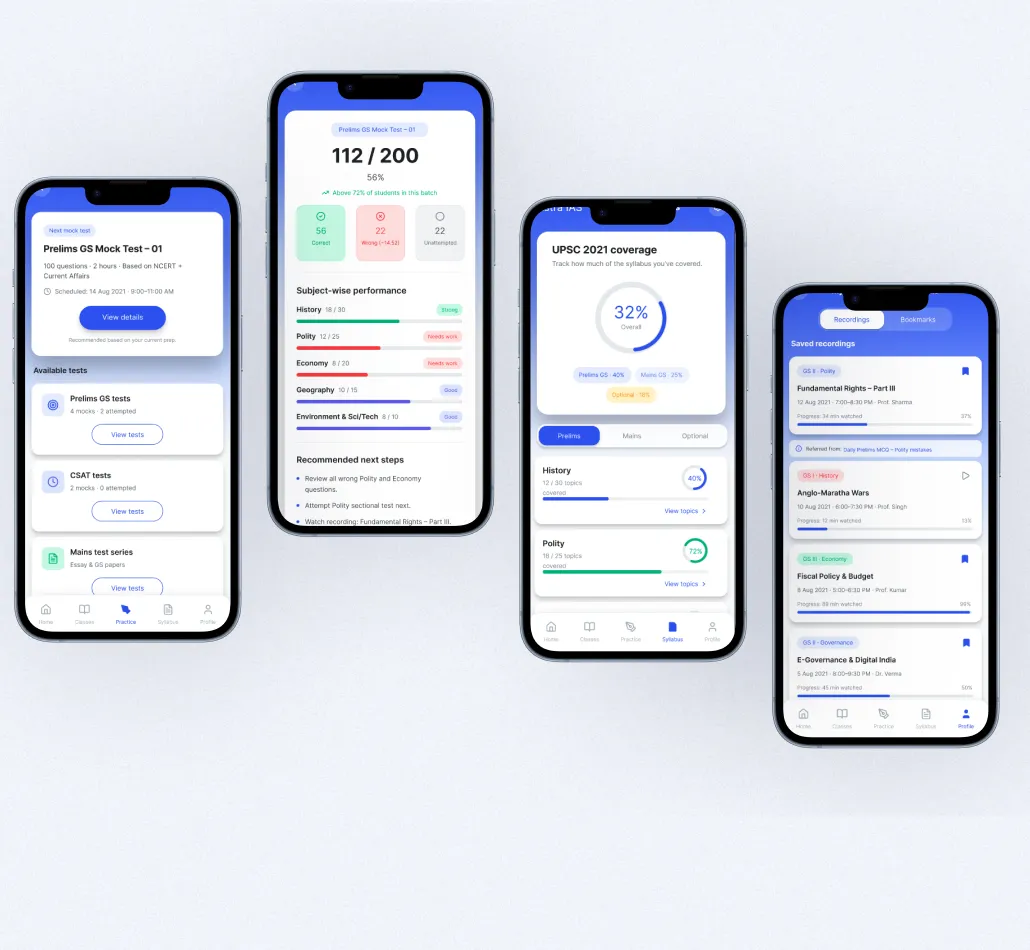
Practice is a loop, not a score: every mock test ends in named weak areas and concrete next steps.
Live class: attendance built into the lesson
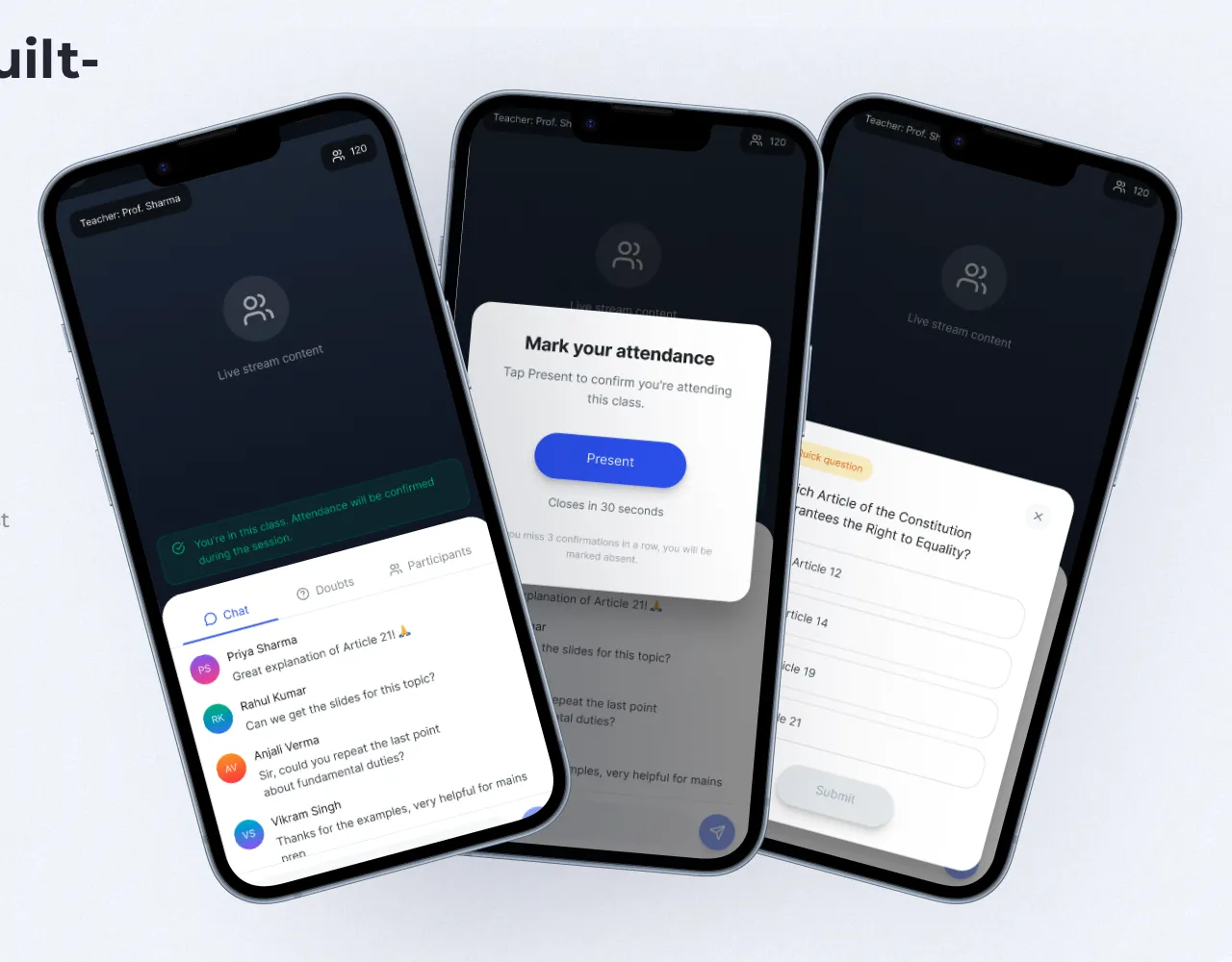
Students never hunt for controls. Attendance and questions arrive inside the class, on a timer.
The teacher console: teach, test, analyse
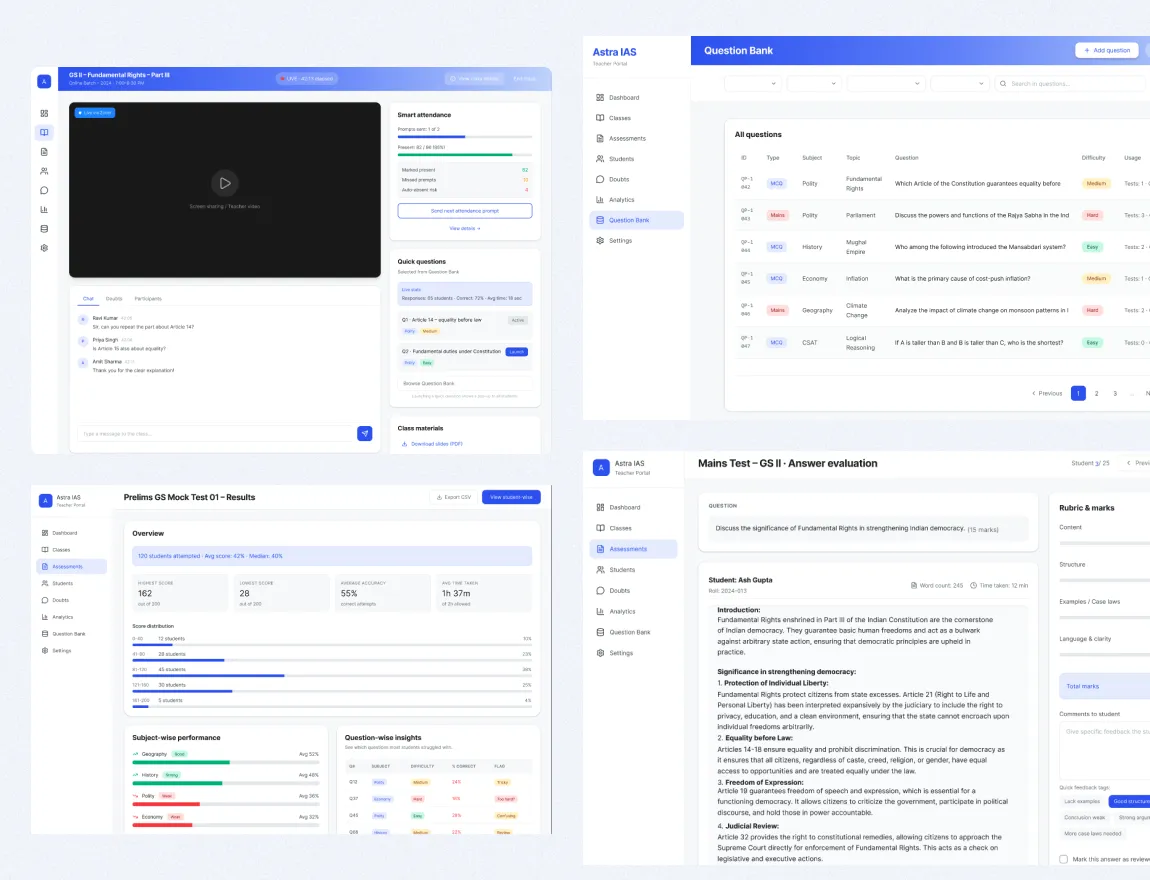
Dense where teachers need density: one console for the class, the bank, the results, and the doubts.
04 · Motion & micro-interactions
Small movements that keep attention in class.
- The attendance prompt counts down visibly, a shrinking ring around the Present button, so urgency is felt without an alarm.
- A soft tick confirms presence and the prompt folds away, returning the screen to the lesson in under a second.
- Result bars fill on reveal, subject by subject, so the verdict reads as a story instead of a spreadsheet dump.
- Recordings remember their position and show watched progress on the card, honoring how revision actually happens.
05 · Honest scope
Built 2020–2022, shown as designed.
The screens carry sample academy data, and I publish no outcome numbers I cannot defend. What Astra proves: I can take an offline institution's whole operating model and give it a coherent digital shape, for three audiences at once.